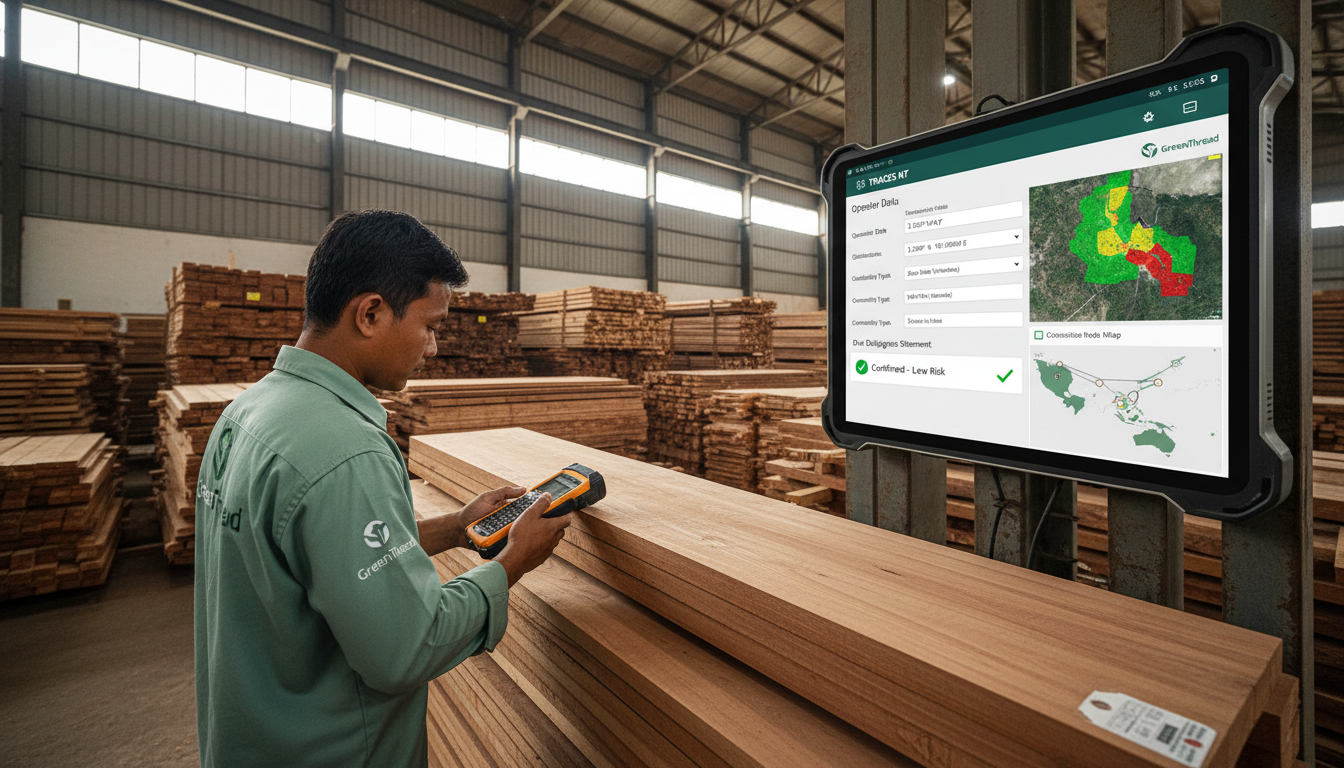
EUDR Is Confirmed. Here Is Where Every Malaysian and Indonesian Wood Exporter Should Start.
EUDR 2026: A Starting Guide for Wood Exporters in Malaysia and Indonesia
If you export timber, plywood, wood panels, or furniture to the European Union, you have probably heard the acronym EUDR by now. You may have also spent time searching for clear guidance, only to find official documents that are hard to locate, harder to navigate, and open to interpretation. That experience is common, and it is not a reflection of your team's capability. The materials are genuinely scattered. This guide pulls together the most useful official resources in one place, so you can stop hunting and start making progress.
Start With the Legal Text Itself
This is the most common piece of advice that people ignore, and the most useful one to follow. Reading the regulation is not as painful as it sounds, and it answers a surprising number of questions that circulate in industry groups and workshops.
The EU has published a consolidated version of the regulation that includes all amendments to date. That is the best place to start:
- Consolidated version of EUDR — incorporates all updates, this is your primary reference
- Original text — Regulation (EU) 2023/1115
- 2024 Amendment — Regulation (EU) 2024/3234
- 2025 Amendment — Regulation (EU) 2025/2650
- Country Risk Classifications — Implementing Regulation (EU) 2025/1093
- Draft Delegated Regulation
Both Indonesia and Malaysia are currently classified as standard risk under the country benchmarking system. That means you are not in the high-risk category, but standard risk still requires a full due diligence statement — it does not mean you are exempt.
The EU Commission's Explanatory Pages
Once you have read the regulation at least once, these two pages are worth bookmarking. They contain practical guidance, FAQs, and updates as implementation progresses:
The Document Library You Should Bookmark
The most practical collection of supporting documents is held on the CIRCABC workspace for the regulation. It is updated regularly and contains materials that answer the operational questions exporters actually face:
This workspace includes the FAQ document (now in its fourth iteration), the user guide for TRACES NT, the list of competent authorities in each EU member state, and the country risk benchmarking results with the methodology behind them.
One document on the EU Publications Office is particularly useful for exporters trying to understand where they sit in the supply chain:
- Understanding your company position — includes example supply chains for timber, plywood, and other commodities
Note that this document has not yet been updated to reflect the 2024 and 2025 amendments, but the supply chain examples remain a helpful starting point.
For country risk classifications specifically, Preferred by Nature has published a clear visual summary that is easier to read than the raw implementing regulation.
Staying Current as the Regulation Evolves
The regulation has already been amended twice since its original publication, and implementation guidance continues to be updated. Subscribing to a small number of reliable sources is more practical than following every development yourself.
The most reliable official source for updates is the EU Commission's official EUDR newsletter. Subscribe directly from the commission's page.
Two competent authority newsletters worth following, even if you need to use a translation tool:
- Bundesanstalt für Landwirtschaft und Ernährung — Germany (subscribe via their site)
- Finnish Food Authority newsletter (subscribe via their site)
The Team Europe Initiative on Deforestation-Free Value Chains is a coordinated programme by the EU Commission and member states (Germany, France, and the Netherlands) to help exporting countries, including Malaysia and Indonesia, prepare for compliance. Their previously released guides and webinars are worth reviewing, and their newsletter is free to subscribe to.
In March 2026, the European Forest Institute and the EU Sustainable Supply Chains Coalition launched a Community of Practice for the EUDR. It brings together companies, competent authorities, and NGOs to share practical experience. It is early days, but it is already one of the more grounded forums for real implementation questions.
Action Steps
- Read the consolidated regulation — focus on Articles 3, 8, 9, and 10, which cover operator obligations and due diligence requirements
- Check your HS codes against the new TARIC codes published to support EUDR customs compliance — your EU importer will need these
- Bookmark the CIRCABC workspace and check it monthly
- Subscribe to the EU Commission's EUDR newsletter
- Contact your EU buyers now and ask what documentation they will require from you — do not wait for them to chase you
Common Questions
Does Malaysia's or Indonesia's standard risk classification mean I do not need to do much? No. Standard risk means a full due diligence statement is still required. The classification affects how much evidence your EU buyer needs to gather about country-level risk, but it does not remove your obligation to provide geolocation data and supply chain documentation (Implementing Regulation (EU) 2025/1093).
Who is responsible for submitting the due diligence statement — me or my EU buyer? The legal obligation to submit a due diligence statement sits with the EU operator placing the product on the market — that is typically your EU importer or buyer. However, they cannot complete it without information from you, including plot-level geolocation coordinates and evidence of legality.
What information will my EU buyer ask me to provide? At minimum: the geographic coordinates of the land where the timber was harvested (polygon or point data), confirmation the land was not deforested after 31 December 2020, and documentation showing the product was legally produced under the laws of the country of origin (Regulation (EU) 2023/1115, Article 9).
Is FSC certification enough to satisfy EUDR requirements? FSC certification is useful evidence but is not, on its own, sufficient to satisfy EUDR due diligence. Geolocation data must still be provided separately. GreenThread's FSC support service can help you understand what your existing certification covers and what gaps remain.
Where can I get hands-on practice with the TRACES NT system before I need to use it for real? The EU provides a testing environment for TRACES NT, separate from the production system. Once current maintenance is complete, you can register and generate a practice due diligence statement. Sign-up details are on the EU's information system page.
If you are not sure where your operation sits relative to EUDR requirements, GreenThread offers a straightforward EUDR readiness review for timber, plywood, and furniture exporters in Malaysia and Indonesia. It takes less than a day of your time and gives you a clear picture of what your EU buyers will ask for and when.
Next in this series: Now that you have the official resources and know where Malaysia and Indonesia sit in the risk framework, the next step is understanding exactly what standard-risk classification means for your specific obligations — GPS polygon data, documentation requirements, and the deadlines that actually apply to your business size. Read: Malaysia Is Standard Risk. No Shortcuts, No Simplified Declarations — Here Is What That Means for Your Timber Business