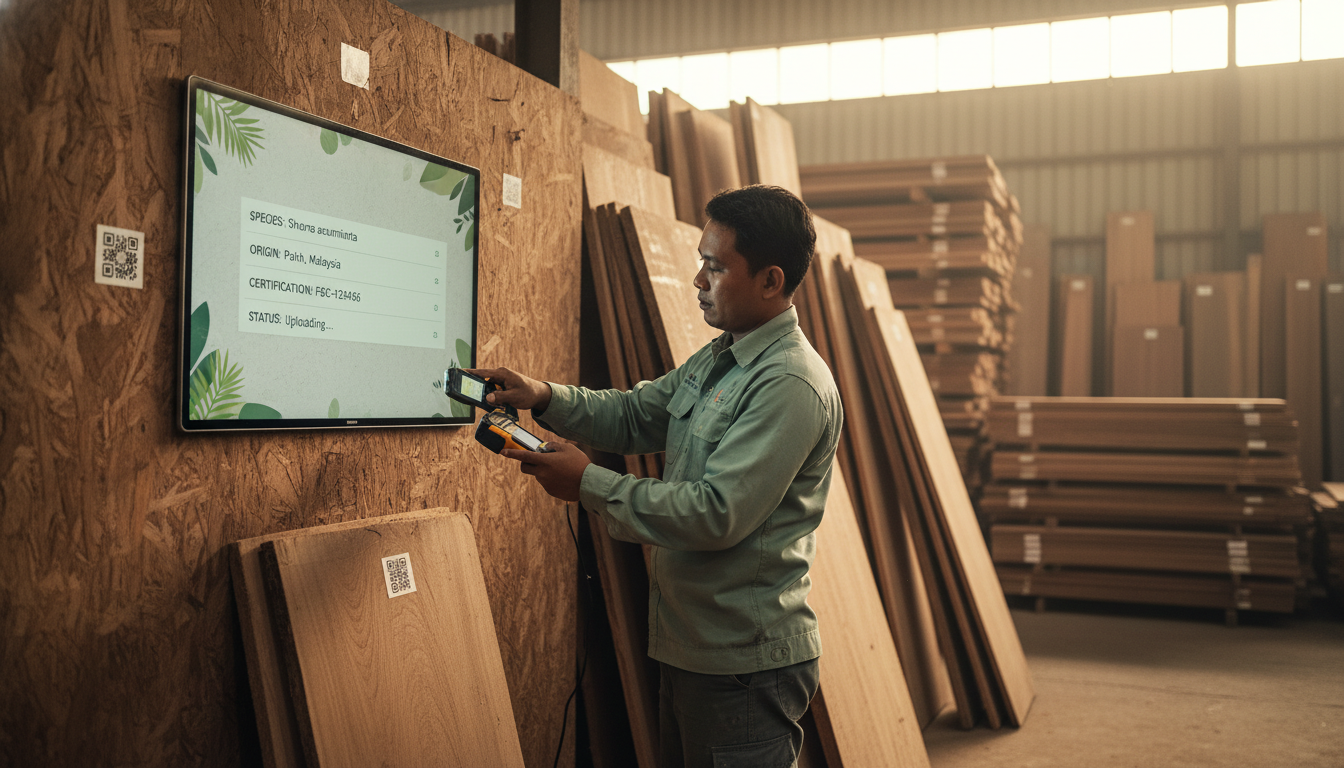
You Are Not Filing the EU Declaration. Your Job Is to Build the Data Passport That Makes Your Buyer's Filing Possible.
What EUDR Means for Your Wood Export Business
If you export timber, plywood, wood panels, or furniture to the European Union, you already know the EU Deforestation Regulation is coming. What is less clear for most SME owners is exactly what your role is, who is responsible for what, and where to start when you do not have a dedicated compliance team.
This guide is written for businesses in Malaysia and Indonesia working through this for the first time. No jargon. No unnecessary complexity. Just a clear picture of what the regulation asks of you — and the single most important thing to understand before you do anything else.
Your Role: Data Custodian, Not EU Declarant
The most important thing a Malaysian or Indonesian wood exporter needs to understand about EUDR is this: you are not the one filing the Due Diligence Statement.
Under Regulation (EU) 2023/1115, it is your EU importer — the company that physically places your products on the EU market — who is legally defined as the "operator" and who must submit a Due Diligence Statement (DDS) to the EU TRACES Information System before each shipment clears. That is their legal obligation, not yours.
Your obligation is different, and it is equally important: you must become an API-ready Data Custodian. This means compiling a complete, digitally structured Digital Data Passport for every shipment — containing verified geolocation polygons, satellite deforestation checks, and MTCS/TLAS legality evidence — and transmitting it directly into your EU buyer's compliance system so they can file their DDS with confidence.
This distinction matters enormously. Malaysian and Indonesian SMEs that misunderstand their role risk two things: attempting to file EU declarations they have no legal standing to make, or — more commonly — failing to build the upstream data infrastructure their EU buyers actually need. Either way, the result is the same: lost contracts.
Your competitive advantage is not regulatory filing. It is becoming the supplier whose Digital Data Passport makes your EU buyer's compliance process frictionless.
Why This Deadline Cannot Be Ignored
The EU Deforestation Regulation (EUDR, Regulation (EU) 2023/1115) requires that all covered commodities — including timber and wood-derived products — placed on the EU market must come from land that has not been deforested after 31 December 2020. EU operators placing goods on the market must submit a due diligence statement before each shipment. The confirmed enforcement deadlines under Regulation (EU) 2025/2650 are:
- Large and medium operators: 30 December 2026
- Micro and small operators (established by 31 December 2024): 30 June 2027
One critical point for Malaysian and Indonesian exporters: under Commission Implementing Regulation (EU) 2025/1093, Malaysia and Indonesia are classified as standard-risk countries. This means the simplified Micro or Small Primary Operator (MSPO) declaration — which reduces documentation requirements for low-risk country origins — is legally unavailable to you. Standard due diligence applies regardless of your company size.
Your EU buyer cannot file their DDS without documentation and geolocation data from you. If you cannot supply that data in the format they need, they will find a supplier who can. The practical consequence is simple: no Digital Data Passport means no EU sales.
What Your EU Buyer Actually Needs From You
Under EUDR, your EU buyer must carry out due diligence and demonstrate that the wood in your products did not contribute to deforestation. They cannot do this without your upstream data. What they need from you is a structured Digital Data Passport — a complete, per-shipment digital record containing:
- Plot-level geolocation data: GPS polygon coordinates for every supply plot over 4 hectares, in GeoJSON or KML format. Point data alone is insufficient for larger plots (Article 9(1)(d), Regulation (EU) 2023/1115). For plots under 4 hectares, GPS point data is acceptable.
- Satellite-verified deforestation check: documented confirmation that no deforestation occurred on any supply plot after 31 December 2020, cross-referenced against current satellite imagery.
- MTCS/TLAS legality evidence: valid MTCS certificates and TLAS permits linked specifically to the geolocated plots, covering land tenure, forestry law, environmental law, labour law, and FPIC where applicable.
- Supply chain traceability: batch-specific records connecting the shipment to the source plots, including species, volume, harvest date, and supplier references.
- API-ready format: the entire Data Passport structured in JSON, GeoJSON, or XML so it can be ingested directly into your EU buyer's compliance software and TRACES filing system.
The key word is API-ready. Your EU buyers are not looking for a PDF folder of documents. They are building automated compliance workflows, and they need your data to flow seamlessly into their systems. The suppliers who invest in this interoperability now will be the ones with long-term EU market access. If you hold FSC certification, this strengthens your position. It does not automatically satisfy EUDR requirements, but it provides a strong legality foundation that EU buyers recognise. Speak to the GreenThread team about FSC certification if you are not already certified.
How to Map Your Supply Chain to Plot Level
The single most common problem for wood product exporters is not the paperwork. It is not knowing precisely where their raw material comes from. Before you can compile a Digital Data Passport, you need a complete picture of your supply chain from log source to factory gate. This means:
- Listing every supplier you buy from, including traders and intermediaries.
- Requiring GPS polygon data for every supply plot as a condition of purchase — a "No Polygon, No Pay" sourcing policy.
- Verifying that each supplier's concessions have valid, current licences under Malaysian or Indonesian forestry law.
This process takes time. Start now, because your EU buyers are already auditing their supply chains and some have begun making polygon data a contractual requirement.
For operations in Malaysia, your primary legality pillars are MTCC chain of custody documentation and valid state forestry department approvals. In Indonesia, the relevant instruments include the IPHH and the SVLK timber legality verification system. These are the foundation of your legality evidence — but they must be linked to specific geolocated plots, not held as general company-level certificates.
Collecting and Formatting Geolocation Data
This is where many SMEs get stuck. Your EU buyer needs GPS polygon coordinates, and for most forest plots that means working with your upstream suppliers to collect them.
Practical points:
- Coordinates must be in decimal degrees format (for example, 3.1390° N, 101.6869° E).
- For plots larger than 4 hectares, you need a polygon — a series of coordinate points outlining the plot boundary. A single GPS pin does not satisfy Article 9(1)(d).
- For plots under 4 hectares, a GPS point is acceptable.
- Many concession holders in Malaysia and Indonesia already have this data. The challenge is getting it into an API-ready format your EU buyer can ingest automatically.
- Free tools like Google Earth Pro allow you to create and export polygon data in KML format, which most compliance platforms accept as a starting point.
- Purpose-built platforms such as TimberID or Ekwato support MTCS/TLAS integration and GeoJSON output — these are worth evaluating if you manage multiple suppliers across different plots.
The polygon data you collect must correspond to the specific harvest batch you are shipping, not a historical concession boundary. EU buyers and competent authorities will verify the correlation between your shipment dates and your geolocation evidence.
Building an API-Ready Due Diligence Process
You do not need an expensive system to get started — but you do need a system that produces machine-readable outputs, not just document folders. A basic EUDR Data Custodian workflow for a wood product exporter looks like this:
- Collect source data: before accepting a new timber lot, request polygon coordinates and legality documents from your supplier. Refuse lots where this data is unavailable.
- Verify and link documents: confirm licences are current and cover the specific harvested area. Link each certificate to the corresponding plot polygon.
- Cross-check against deforestation data: verify that no tree cover loss occurred on any supply plot after 31 December 2020, using tools such as Global Forest Watch or Satelligence. Document the satellite source and verification date.
- Conduct a formal written risk assessment: Malaysia's standard-risk classification means this cannot be a one-time general statement. It must be executed per batch, per supplier, and retained for a minimum of five years.
- Compile your Digital Data Passport: assemble all of the above into a single, structured digital record per shipment in API-ready format (JSON, GeoJSON, XML).
- Transmit to your EU buyer: send the Data Passport before or at the time of dispatch. Confirm your buyer has successfully ingested it into their system ahead of their own TRACES filing.
Doing this consistently, for every shipment, is what compliance looks like in practice. Your EU buyer is legally responsible for the DDS filing — your obligation is to make their filing possible by providing flawless upstream data.
The Software Question: API Interoperability, Not EU Filing Tools
One of the most common mistakes Malaysian SMEs make when evaluating compliance software is assessing platforms on their ability to generate EU regulatory filings. You do not need software that files EU declarations. You need software that produces API-ready Digital Data Passports your EU buyers can pull directly into their own systems.
When evaluating platforms, prioritise:
- API output compatibility with EU buyers' IT architecture and the TRACES IS
- MTCS/TLAS integration so your legality certificates are linked to specific plots automatically
- GeoJSON/KML polygon support for all harvest plot data
- Batch-level traceability so each Data Passport is uniquely tied to a specific shipment and invoice
This is exactly where GreenThread can help. Rather than purchasing software designed for EU operator filings, GreenThread guides Malaysian and Indonesian SMEs to invest in B2B digital interoperability — API-ready platforms that transmit your deforestation-free verification and legality evidence directly into your EU buyers' compliance architecture. This is the hook that converts your compliance investment into a genuine competitive advantage: you become the supplier whose data arrives clean, structured, and ready to use.
Action Steps
- Confirm which of your products fall under EUDR Annex I — timber, plywood, wood panels, and furniture with wood components all qualify.
- Determine your enforcement deadline: 30 December 2026 (medium/large) or 30 June 2027 (micro/small) — and note that Malaysia's standard-risk status means the simplified MSPO declaration is unavailable regardless of size.
- Contact your EU buyers now and ask what API format they need your Digital Data Passport delivered in.
- Implement a "No Polygon, No Pay" sourcing policy with every upstream supplier immediately.
- Begin collecting GPS polygon data for all active supply plots — this is the longest single task in the process.
- Evaluate API-ready traceability platforms with MTCS/TLAS integration. Contact GreenThread for a shortlist matched to your operation size.
- If you are not FSC certified, speak to GreenThread about whether FSC certification with the Regulatory Module strengthens your Data Custodian position.
Common Questions
Does EUDR apply to me if I am a manufacturer, not a logger? Yes. If your finished product contains wood and is exported to the EU, the regulation applies. You are a Data Custodian in the supply chain, and your EU buyer needs your Digital Data Passport to complete their own Due Diligence Statement. Your role is upstream data provider, not EU declarant.
What if I cannot get geolocation data from my timber supplier? This is a real and common problem. In the short term, raise it with your EU buyer so they are aware. In the longer term, enforce a "No Polygon, No Pay" policy and provide polygon collection training for smallholder suppliers using mobile GPS tools or government-subsidised mapping services. Your EU buyer will increasingly make polygon data a condition of purchase — getting ahead of this protects your supply contracts.
Does SVLK or MTCS certification satisfy EUDR? It is your primary legality pillar, but not a complete substitute. SVLK and MTCS demonstrate legal harvesting and are a critical part of your Digital Data Passport. However, EUDR also requires satellite-verified proof of no deforestation after 31 December 2020, which these schemes do not specifically address. You still need the polygon data and a deforestation check linked to specific plots.
Do I submit a Due Diligence Statement to the EU TRACES system? No. As a Malaysian or Indonesian exporter, you are not the legal "operator" under EUDR — your EU importer is. They are solely responsible for filing the DDS to TRACES. Your obligation is to compile and transmit a complete Digital Data Passport that gives them everything they need to file accurately. Do not attempt to submit to TRACES directly — you do not have the legal standing to do so and this creates jurisdictional confusion that puts your EU buyer's compliance at risk.
When does EUDR enforcement actually begin? The confirmed deadlines under Regulation (EU) 2025/2650 are 30 December 2026 for large and medium operators and 30 June 2027 for micro and small operators established by 31 December 2024. However, your EU buyers are already building their compliance systems now and requesting Digital Data Passports ahead of these dates. The time to start is not when your buyer asks — it is now.
What about legacy timber stock harvested before June 2023? Timber harvested before 29 June 2023 that is placed on the EU market from 30 December 2026 continues to be governed by the EU Timber Regulation (EUTR) under the Article 37 amendment, until the definitive cut-off of 31 December 2029. Maintain strict physical and digital segregation between legacy EUTR-governed stock and new EUDR-governed timber, and reflect this distinction clearly in your Data Passport records.
Next in this series: The European Commission published a major EUDR simplification package on 4 May 2026 — confirming no further delays, no reopening of the regulation, and a TRACES system relaunch in June 2026. Here is exactly what it means for Malaysian and Indonesian timber exporters, and why your Data Passport infrastructure needs to be ready now. Read: The EU's 4 May 2026 EUDR Package: What Malaysian and Indonesian Timber Exporters Need to Know Right Now
If you are not sure where your Data Custodian readiness gaps are, GreenThread offers a straightforward 30-minute readiness review — assessing your polygon data, standard-risk due diligence gaps, and API integration readiness. We will give you a prioritised action list to become an EU buyer's preferred supplier before the December 2026 deadline. Book a free review